


Pringles Index explained
- Removing VAT brings the UK’s Pringles price much closer to the US benchmark
- Pack size affects both the upfront cost to shoppers and the price they pay per gram
- Overseas pricing decisions need to account for promotions, supply costs and local incomes
Pringles costs roughly two and a half times as much per gram in Turkey as it does in the US, according to a new price comparison across 30 markets. Hungary is more expensive than Switzerland, while France and India share the lowest price – raising the question of why buying the same snack costs so much more in some countries than others.
The Pringles Index has been created by Michael van der Looij, whose work in finance sparked an interest in how the same product is priced around the world. By choosing a widely sold snack as his benchmark, he’s given producers considering an overseas launch a way to compare pack sizes and prices, and investigate how tax, distribution and promotions would affect their own offer. The UK, for example, looks considerably more expensive than the US until VAT is removed from the British price.
Van der Looij runs specialist website World of Chips alongside his role as finance director at a global gaming company. His inspiration came from The Economist’s Big Mac Index, which compares the price of McDonald’s flagship burger across countries to explore currencies’ purchasing power. The Pringles Index compares regular retail prices of Pringles Original per 100g, converted into US dollars using late-October exchange rates, with each entry identifying the source, pack weight and confidence level.
“I wanted a simple way to show how differently the same snack is priced around the world,” he says. He has used the Big Mac Index in his own work on international pricing: “Setting a good price point is complicated by differences in disposable income, VAT and inflation, and the Big Mac Index is often one of the inputs.”
How much of the price goes to the taxman?

Turkey tops the Index at $3.96 per 100g, based on a 165g can priced at 325 lira on Turkish online marketplace Trendyol. The US benchmark is $1.61 per 100g, calculated from Walmart’s regular $2.38 price for a 147.4g can.
Van der Looij identifies inflation and exchange-rate movements as contributors to Turkey’s position. Retailer listings describe cans imported from Poland and Belgium, while he says Turkish prices have risen faster than the lira has weakened, making the product more expensive when converted into dollars.
According to his tax analysis, Turkey applies just 1% VAT to crisps, so removing it barely changes the country’s position. A manufacturer exploring a Turkish launch could use the Pringles price as one reference when researching competing snacks, then examine import costs, distributor charges and retailer terms to calculate whether it could supply a product at a competitive price.
Hungary’s $3.14 per 100g puts it above Switzerland’s $2.16 and the UK’s $2.02, but Hungary’s taxes account for a sizeable part of its price. Van der Looij says Hungarian crisps attract 27% VAT alongside a public health product tax of 390 forints per kilogramme on salty snacks – approximately 64 forints on a 165g can priced at 1,699 forints.
Removing VAT alone brings the Hungarian price to about $2.47 per 100g and moves the country from second to fourth in his ranking. The premium over the US falls from approximately 94% to 53%. Any producer using that retail price to work backwards towards a viable wholesale price would have to allow for both taxes, as well as the costs and margins of supplying the retailer.
The UK’s £2.50 price for a 165g can works out at $2.02 per 100g, around 25% above the US benchmark. Strip out its 20% VAT and that becomes about $1.69, bringing the difference down to roughly 5%. Since the US listing excludes sales tax, putting the prices on the same tax basis brings the two markets much closer together.
A manufacturer assessing an overseas launch can therefore make the same calculation for competing products before deciding its own price. Deducting applicable taxes from the proposed shelf price establishes how much remains to cover production, freight, distributor charges and retail margins.

How the Pringles Index is calculated
The index compares one standard can of Pringles Original per country at its regular, non-promotional retail price, using one main source per market. Prices are converted into US dollars per 100g using ECB reference rates from 26 October 2026, with national rates from 23 October for Russia and Egypt and the fixed dollar peg for the UAE. The US benchmark is set at 100, and US prices exclude sales tax.
Red bars show prices above the US benchmark; green bars show prices below it. Asterisks identify lower-confidence entries based on price ranges, marketplace listings, undated sources or potentially promotional prices. The figures represent a snapshot of selected prices rather than national averages.
The cheaper pack can cost more per gram

Pringles cans in the Index range from around 102g to 195g, so comparing what shoppers spend on a tube means comparing quite different quantities. Calculating the price per 100g reveals differences even within a single market: van der Looij found that the Hungarian 125g can costs roughly 16% more per gram than the 165g format.
A producer deciding what pack size to launch in a new market can use those figures to weigh up affordability against value per gram. A smaller pack may suit shoppers with a fixed amount to spend, while a larger format can offer better unit value to people willing to pay more upfront. Research into local budgets and buying habits would help establish which offer is more likely to sell.
France, for example, combines a larger can with one of the lowest prices per gram in the Index. Its $1.08 per 100g figure comes from a 195g can priced at €1.89 at supermarket chain Intermarché – 30g more than the 165g format common elsewhere in Europe.
Van der Looij also found that French 175g cans work out at approximately $1.10 to $1.50 per 100g across other listings. India’s entry uses the maximum retail price of 110 rupees for a 107g can, equivalent to around $1.08 per 100g.
His research also highlights how often shoppers can buy below the regular shelf price. Multibuys and deep discounts are common in France, he says, potentially encouraging consumers to wait for an offer before buying Pringles.
A producer planning to compete in such a market needs to budget for the frequency and depth of offers, including how much of the discount it would fund. Tracking prices across the promotional calendar would give it a better basis for forecasting revenue than assuming every pack will sell at the regular price.

Red bars indicate prices above the US benchmark; green bars indicate prices below it. Differences reflect exchange rates alongside factors such as tax, import costs and local competition.
Who decides what a tube is worth?
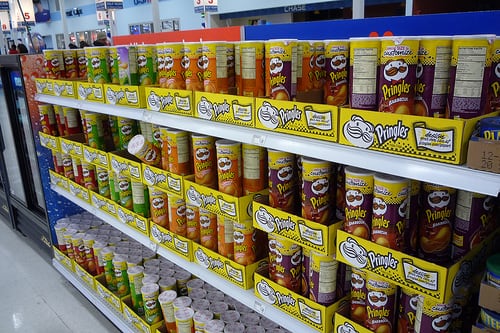
Manufacturers influence the cost of getting a snack onto the shelf through their wholesale prices and commercial terms, while retailers decide what shoppers ultimately pay. According to the UK’s Competition and Markets Authority (CMA), supermarkets’ prices depend significantly on how much they pay their suppliers.
Suppliers can also recommend a retail price, although CMA guidance says retailers must remain free to charge a different amount. A brand can therefore suggest where its product should sit on price, while individual chains decide how much to charge.
Pringles owner Mars, Inc. says the brand is sold and distributed in approximately 130 markets worldwide, with more than 100 flavours offered, and that retailers have the final say on the prices shoppers pay. “While final pricing is at the sole discretion of retailers, we will always work to offer our snacks at the best possible value,” says a company spokesperson.
Producers using the index to assess a potential market should therefore examine both the terms on which they could supply retailers and the prices those retailers charge for competing products. When negotiating a listing, they also need to understand how their proposed product would fit the retailer’s range and promotional plans, whether as a smaller entry pack, a larger sharing format or an alternative priced above or below an established brand.
To build a reliable pricing comparison, Van der Looij recommends comparing prices per 100g excluding tax across several retailers, weighting the figures towards what shoppers actually pay once promotions are included, and tracking local-currency prices over time.
“A conversion at one exchange rate on one day hides currency swings and local inflation,” he says. “Retailer margins and distribution costs vary by channel. And a dollar price says nothing about what the can costs relative to local incomes.”
He also recommends adding an affordability measure against local earnings and plans to develop the index with at least two retailers per country, presenting a range of prices for each market.
Before entering a new market, a brand owner needs to know whether it can supply a pack that shoppers can afford, retailers want to stock and the business can sell profitably. The index gives producers a benchmark, while their own costs and local consumer research will help determine whether they can compete.
