


Key takeaways:
- The most memorable food marketing campaigns aren’t always planned – brands like Nestlé, Calbee, Burger King, KFC and Heinz proved that operational challenges can become powerful brand-building opportunities.
- Success depended less on the crisis itself than on how companies responded, using humour, honesty and consumer participation instead of corporate damage control.
- As supply chains become more volatile and social media amplifies every disruption, marketing teams must be ready to turn unexpected setbacks into opportunities for engagement rather than reputational risk.
Twelve tonnes of KitKat bars disappearing from the back of a lorry should have been a disastrous logistics story; Calbee stripping the colour from its crisp packets should have been another tale of supply-chain disruption. Instead, both became marketing success stories that generated global headlines and millions of social media interactions, with KitKat’s response eventually collecting the PR Grand Prix for Crisis Communications at the 2026 Cannes Lions International Festival of Creativity.
Neither company set out to create a viral marketing campaign. Nestlé was responding to the theft of 12 tonnes of KitKat bars, while Calbee was simply trying to keep products on supermarket shelves despite disruption to packaging materials. Yet both discovered something many food manufacturers are only beginning to appreciate: consumers are often more interested in how brands respond when things go wrong than they are in another carefully choreographed advertising campaign.
Traditionally, crisis communications has focused on containing bad news, protecting reputations and moving the story on as quickly as possible. That instinct hasn’t disappeared, but social media has changed the rules. Every packaging change, logistics problem or production hiccup now has the potential to become public within minutes, leaving companies with a choice between trying to suppress the story or finding a way to make it work in their favour.
Consumers don’t expect brands to be perfect. They do, however, expect them to respond like humans when things go wrong, and companies that manage that well often earn more goodwill than months of conventional advertising could ever buy.
The best campaigns weren’t campaigns at all
Nestlé’s response to the theft of its KitKat shipment shows just how quickly an operational problem can become a marketing opportunity when a brand is prepared to embrace the unexpected.
Earlier this year, thieves stole approximately 12 tonnes – or 413,793 KitKat bars – while the chocolate was being transported from Italy to Poland. On paper, the incident had all the ingredients of a reputational headache. Questions about supply-chain security and organised theft rarely generate the sort of publicity any manufacturer wants.
KitKat could have responded with a standard corporate statement before quietly moving on. Instead, the brand acknowledged the theft with humour, joking that it had “always encouraged people to have a break”, but that “it seems thieves took the message too literally.”
The light-hearted response struck exactly the right note. More than 115 brands joined the joke across social media, dramatically extending KitKat’s reach beyond its own audience. What began as an isolated criminal incident evolved into one of the year’s most talked-about marketing moments, generating more than two million engagements, a 31% share of voice across 93 markets and an estimated $224m in earned media without paid advertising.
The campaign later collected the PR Grand Prix for Crisis Communications, alongside multiple Gold, Silver and Bronze Lions at the 2026 Cannes Lions International Festival of Creativity.
David Rennie, executive VP and head of Strategic Business Units, Marketing and Sales at Nestlé, said the awards demonstrated “he power of consistency, distinctiveness and cultural relevance in brand building.” Nearly seven decades of the ‘Have a Break. Have a KitKat.’ platform gave consumers a joke they instantly recognised, while allowing hundreds of other brands to join in and amplify the message.
Japanese snack manufacturer Calbee found itself facing a completely different challenge, although the outcome proved remarkably similar.
As tensions in the Middle East disrupted petrochemical supply chains and raised concerns about shipping through the Strait of Hormuz, Calbee found itself facing an unexpected packaging challenge. Uncertainty surrounding the supply of printing materials forced the producer to simplify the packaging on several snack products, replacing its familiar colourful designs with monochrome versions to conserve resources while maintaining production. There was no elaborate rebranding exercise or limited edition marketing stunt behind the decision. Calbee was simply trying to navigate another geopolitical supply-chain shock while keeping products available for retailers and consumers.
Manufacturers spend millions making packaging brighter and more distinctive because colour plays an important role in attracting shoppers on crowded supermarket shelves. Calbee was forced to do the opposite, yet consumers turned what looked like a disadvantage into an unexpected asset.
After manga artist Itsuki Sayaka shared illustrations she had drawn directly onto the monochrome packs, other artists, hobbyists and fans quickly followed suit. What began as a single social media post has rapidly evolved into a growing online trend, with consumers using Calbee’s plain packaging as a canvas for anime characters, original artwork, humorous sketches and personalised designs.
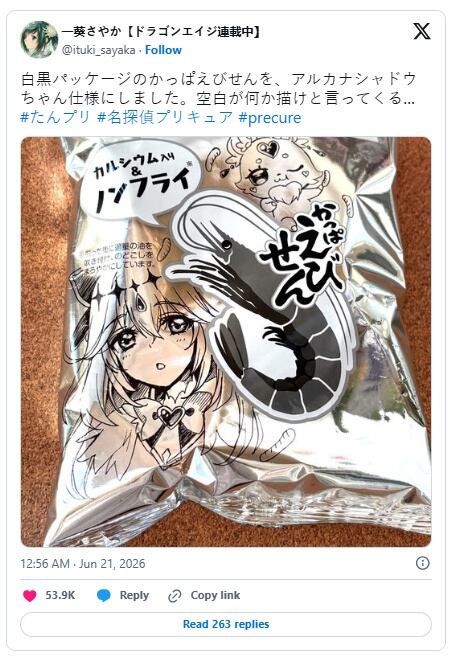
The company hadn’t commissioned an advertising campaign, hired influencers or launched a design competition. Consumers are doing all of that themselves, creating exactly the sort of organic engagement that marketing teams spend millions trying to achieve.
Consumers don’t just watch the campaign anymore

The same pattern appears in several of the food industry’s most celebrated marketing campaigns.
When Burger King launched its Mouldy Whopper campaign in 2020, the company deliberately showed one of its signature burgers decomposing over 34 days. At first glance, the idea seemed almost absurd. Food manufacturers have traditionally invested heavily in making products look fresher, bigger and more appetising, yet Burger King chose to highlight mould because it reinforced a much bigger message.
By removing artificial preservatives, the company argued that mould was no longer something to hide but visible proof that the recipe had changed. The campaign challenged decades of conventional food advertising and won numerous international creative awards because it transformed what many consumers would regard as a weakness into evidence that the product had improved.
KFC reached a similar conclusion after its well-publicised chicken shortage in 2018 left hundreds of UK restaurants unable to serve their signature product.
The company could have relied on a carefully worded corporate statement but instead published a full-page newspaper advertisement featuring an empty bucket carrying the now-famous ‘FCK’ logo. The advert apologised directly to customers, accepted responsibility without qualification and used humour to acknowledge the scale of the disruption. Years later, it remains one of the best-known examples of crisis communications because it treated consumers like people rather than simply issuing another corporate apology.
Heinz took a different approach in 2021 with its Draw Ketchup campaign but arrived at much the same destination. Consumers were asked to draw a bottle of ketchup from memory, and the overwhelming majority instinctively drew Heinz. Rather than telling shoppers it owned the category, Heinz let consumers make the point themselves.
These campaigns highlight how marketing has evolved. Consumers increasingly want to do more than watch a campaign unfold – they want to contribute to it. Whether that’s adding their own joke, sketching a ketchup bottle or turning a monochrome crisp packet into a work of art, participation has become every bit as valuable as the original creative idea.
When problems become promotions
None of this suggests companies should welcome factory shutdowns, logistics failures or ingredient shortages. Operational problems remain expensive, disruptive and, in many cases, entirely avoidable.
What has changed is the way those problems are managed once they become public.
Recognising an opportunity in the middle of an operational crisis requires close coordination between supply-chain, communications and marketing teams. Had Nestlé tried to hide the KitKat theft or had Calbee dismissed the artwork appearing on its packaging, both stories might have amounted to little more than negative headlines. By recognising public interest early, both companies gave consumers a reason to engage rather than simply move on.
Of course, not every operational issue lends itself to this approach. Food safety incidents, contamination events and consumer health concerns demand transparency, speed and accountability above all else. Humour has clear limits, and companies need to recognise where those limits lie.
Nestlé, Calbee, Burger King, KFC and Heinz all discovered the same thing: once consumers are talking about your brand, the question isn’t whether you can control the story but whether you can add something worth talking about.
The next award-winning campaign may not begin with an agency pitch or months of consumer research. It may begin with an unexpected operational challenge, a marketing team prepared to think differently and a business confident enough to trust consumers to take the idea further.
And in today’s food industry, that may prove to be the smartest marketing strategy of all.