


Key takeaways:
- Manufacturing still has a visibility problem for women, with historical perceptions and a lack of female role models continuing to shape who applies for and progresses in operational leadership roles.
- Phillips credits emotional intelligence and people leadership as critical advantages on the factory floor, arguing that high-performing food manufacturing operations are ultimately driven by strong teams.
- The industry must do more to attract new talent, she says, by better showcasing the variety, progression and technical opportunities available in modern food manufacturing careers.
Rebecca Phillips has spent nearly three decades in food manufacturing – long enough to know the industry’s strengths, weaknesses and blind spots.
She started in 1998 as a graduate trainee at a red meat company and quickly moved into quality control, a role that put her shoulder to shoulder with production teams on the factory floor. But she soon realised she didn’t want to stay in a single function.
“I realised quite early on that for me, quality was too narrow a career path,” she says. “I didn’t just want to run one specific function – I wanted to run an entire operation from beginning to end.”
“As a stubborn Yorkshire girl, it actually gave me a fire in my belly and spurred me on to prove them all wrong and show that an empathetic, servant leadership style can deliver great results.”
Rebecca Phillips
That ambition now sees her leading one of the UK’s busiest biscuit factories. As general factory manager at Fox’s Burton’s Companies’ Llantarnam bakery, Phillips oversees more than 700 staff producing around 4.4 billion biscuits a year, including more than 274 million packs of the classic British treat.
Manufacturing’s pace is what keeps her hooked. “That sense of making an impact at every stage of the production is what drew me to manufacturing in the first place, and it’s what keeps me going today,” she says. “I also love the pace, challenge and the variety. No two days are ever the same.”
It’s hardly an easy career path, she adds. “It’s demanding, it’s not the most glamorous, and it’s certainly not a 9–5 role, but I absolutely love it.”
‘I was told I’d never achieve my ambitions’

Phillips’ career hasn’t unfolded in a vacuum. Manufacturing remains heavily male dominated, particularly in operational roles and engineering – and she’s experienced that first-hand. Early on, someone told her outright that being a woman would limit her career prospects.
“I was told I would never achieve my aspirations because I was female.”
On another occasion, when she was promoted into management, a member of the team left rather than work for a woman. “Unfortunately, those kinds of comments were pretty standard in my line of work at that time.”
Looking back, she says the impact didn’t fully register until much later in her career. “I don’t think I properly realised the prejudice I had faced during my career until I was in my early 40s.”
But the comments had an unintended consequence. “As a stubborn Yorkshire girl, it actually gave me a fire in my belly and spurred me on to prove them all wrong and show that an empathetic, servant leadership style can deliver great results.”
That philosophy runs counter to the stereotype of the hard-nosed manufacturing manager.
Phillips describes emotional intelligence as her ‘superpower’. In high-volume food production, she argues, the ability to build relationships and motivate teams is a commercial advantage. “The ability to build strong relationships, read situations, motivate teams and lead with empathy is a real strength on the factory floor and in senior leadership. High performance in food manufacturing is driven by people, and strong people leadership is a competitive advantage.”
Manufacturing’s perception problem
Gender imbalance remains a reality across much of the manufacturing world, but Phillips believes the root cause runs deeper than long hours or physical work.
“The bigger barrier is historical perception and visibility,” she says. “For decades, manufacturing was positioned as a ‘male’ career path, which shaped who was encouraged to apply, who progressed, and ultimately who was seen in leadership roles.”
That lack of visible role models still matters. “When you don’t see people who look like you at senior levels, it can be harder to picture yourself there.”
In nearly 30 years in operations, Phillips says she’d worked for only two female operational leaders before joining Fox’s Burton’s Companies. Culture also plays a role in changing that equation.
“One of the reasons I value being at Fox’s Burton’s Companies is that it has opened doors for people from many backgrounds and created an environment where I can be my authentic self while delivering strong outcomes.”
For women considering a career in the sector, her advice is straightforward. “Back yourself. Be confident in your capability, be resilient and lean into your emotional intelligence.”
She also stresses another point: “You don’t have to fit a traditional mould to succeed in this industry.”
Food manufacturing’s talent challenge
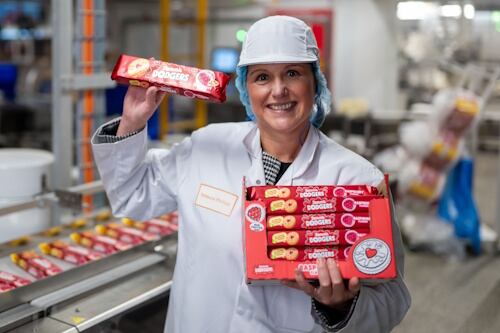
If the sector has made some progress on diversity, it’s still struggling with another issue: attracting talent. “One of the challenges facing manufacturing at the moment is attracting talent due to the misconception that it isn’t a career with long-term progression,” Phillips says.
That perception is out of date. The industry offers technical careers, leadership opportunities and the chance to shape global food production – but too often fails to communicate that.
“Manufacturing might not look glamorous from the outside, but on the inside, it’s varied, exciting and deeply rewarding.”
Fox’s Burton’s Companies is trying to address the issue through engineering apprenticeships and development programmes designed to bring younger workers into the sector. “These equip young workers with the skills to innovate and grow within the industry as well as clearly showcase career progression.”
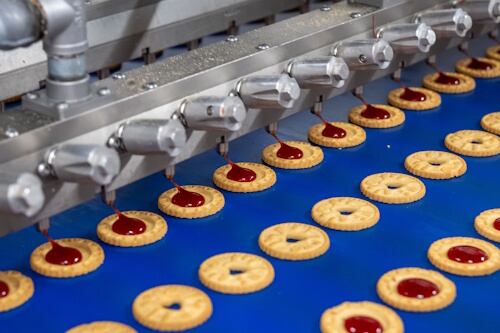
Investment in technology is another lever. At Llantarnam, upgrades to packaging technology for Jammie Dodgers have boosted efficiency while supporting quality improvements and innovation. But Phillips says the industry still needs to do more to explain what modern manufacturing actually looks like. “From a manufacturing and baking perspective, I don’t think we’re doing enough to showcase the breadth of job opportunities that the industry offers,” she says. “I remember leaving university and not really knowing where I could go next, but it’s a career that has no limits.”
Working in biscuits does at least come with one obvious perk. “You can’t work in this industry and not love what you produce,” Phillips says.
Asked for her favourite bakery item, she doesn’t hesitate.
“Probably Jammie Dodgers,” she says, before adding that Wagon Wheels run a close second.
Women in manufacturing
International Women’s Day falls on Sunday 8 March 2026.
Women now make up 28.4% of the UK manufacturing workforce. That was up 1.6 percentage points year on year, according to the 2025 Women in UK Manufacturing report.
Women hold 24.8% of managerial, director and senior roles in UK manufacturing. The same report frames that as progress – but still some way off parity.
The manufacturing gender pay gap in the UK stands at 14.9%. That’s improved versus 2023 but remains above the national average.
Women represent roughly half of the UK labour force – but less than a third of manufacturing workers.
Only 16.9% of the UK engineering and technology workforce is female, highlighting the pipeline challenge feeding into industrial roles.
Just 17% of engineering and technology apprenticeship starts are by women, despite growing demand for technical skills.
Industry groups are targeting 35% female representation in manufacturing by 2035 as part of a national push to improve gender balance.
Globally, women account for around 30%-35% of the workforce across manufacturing, supply chains and transportation.